Frequently Asked Questions


What is a PD&E Study?


In 1970 the federal government passed the National Environmental Policy Act (NEPA), which mandates that prior to obtaining federal funding for a project, a study must be prepared that evaluates impacts to the environment that may result from the proposed improvement.


The FDOT follows the Project Development and Environment (PD&E) Study process to define the most appropriate location and design for major transportation improvements on federal and state facilities in the state of Florida. The PD&E Study phase provides an interface between the Planning and Design Phases to evaluate and document solutions

to transportation needs that are compatible with the human and natural environment.


The PD&E Study determines if there is an engineering, socially acceptable, and

environmentally feasible alternative to meet projected future travel demands.

The study process includes identifying potential project issues; the development of alternative location and design concepts; and the analysis of potential social,

economic, and environmental impacts. Engineering design concepts are developed and evaluated for environmental compatibility and satisfaction of the transportation needs.


What is "Public Involvement"?


The PD&E process includes a Public Involvement Program (PIP) to inform and involve

all interested parties in the development of the planned transportation project. The program for this project includes this web site, meetings and workshops with interested stakeholders, coordination with state and federal agencies and coordination with local governments. Public involvement starts at the beginning of the PD&E process to obtain input from citizens and agencies within the project area and continues through the duration of the project. The public's input is an essential part of the PD&E Study. By working together, transportation improvements can be provided that are beneficial to the community and minimize impacts to the environment.  Near the end of the study,

a formal public hearing is held.  Public involvement efforts will also be continued during the design phase of the project.


When will design start?


The design phase of the project is scheduled to begin early 2009 and is estimated to

take three years to complete.


When will construction start?


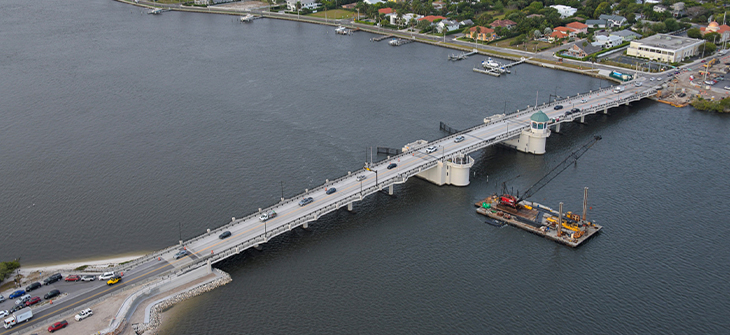
The earliest that construction could possibly start would be sometime in early 2013.  It is estimated that 24-40 months will be required to construct the replacement bridges.


Why are environmental factors evaluated?


Environmental impact evaluation was introduced into the analysis of federal aid projects

in 1970 through the National Environmental Policy Act (NEPA), along with other state and federal environmental statutes, to ensure that environmental issues are considered

along with engineering factors and socio-economic concerns for all construction projects using federal dollars.


What factors are evaluated?


Factors evaluated include the following:  Impacts to residents and businesses, impacts

 to recreation/conservation areas, amount and quality of wetlands (including seagrasses) potentially affected, endangered species habitat encroachment, traffic noise impacts, air quality impacts, identification of historic and archaeological sites and floodplain encroachment.  In addition, project costs, construction time and maintenance of traffic during construction are considered.  Potentially contaminated sites (petroleum or hazardous materials) are also identified during the study.


How will this environmental information be used?


The goal of the PD&E study is to select the best alternative for the proposed improvements which balances environmental, engineering and socio-cultural issues.

The Preferred Alternative needs to address the transportation needs but minimize

impacts to the environment and community.  To assist in the decision-making process,

an evaluation matrix is prepared to compare the potential impacts of each alternative.  Input from the public is also an important factor considered during the evaluation

process.